The Samoyed / Origins & History
Origins & History of the Samoyed
From the reindeer trails of northern Siberia to the great polar expeditions and the first British kennels: the story of a working dog whose partnership with people helped shape the breed we know today.
A Life Shaped by the North
Long before the Samoyed had a breed standard, a show-ring silhouette or a place in the family home, dogs of its northern ancestry lived and worked alongside communities in Russia and Siberia. The environment demanded resilience. Winters were long, travel could be difficult, and the needs of people, animals and their surroundings were closely connected.
The breed’s name comes from an older collective term applied to several northern peoples, including the Nenets. It is important not to mistake that historical label for a single, uniform people or to imagine that every dog kept across this vast region belonged to one modern pedigree breed. Communities differed in language, traditions, livelihood and the ways they worked with dogs. The Samoyed as a recognised breed developed much later from this broader northern background.
For many of these communities, reindeer were central to life. Herds supplied food and materials, and their seasonal movements shaped where people travelled and made camp. Reindeer hides could be used for clothing and shelter; their insulating qualities mattered in a climate where protection from cold was essential. The older accounts of northern life describe portable dwellings, journeys across tundra and forest country, and the continual work involved in managing animals and provisions. This was the world in which the ancestors of the Samoyed found their purpose.
Reindeer, Camps and the Dogs Beside Them
The transition from hunting wild reindeer to managing domestic herds was a long and complex history, not a single event. Herding communities followed grazing patterns and seasonal routes, and dogs could be invaluable where animals needed to be gathered, moved or kept together. A useful dog needed more than enthusiasm: it had to respond to people, work around other animals and cope with hours of activity in difficult conditions.
The historical roles of northern dogs were varied. In some areas they helped herd reindeer; elsewhere they hunted or pulled sledges. The FCI’s historical account of the Samoyed distinguishes dogs used for herding in more southerly areas from white hunting and sledge dogs farther north. It also records that these dogs were not always white: black, brown and parti-coloured dogs formed part of the wider background from which the modern breed emerged.
Imagine the practical rhythm of such a life: camp broken down and possessions gathered, reindeer moving across the landscape, dogs travelling with their people and settling again when the day’s work ended. The work was demanding, but it did not necessarily end with the journey. Dogs lived close to the families who depended on them. The FCI’s breed history specifically notes that dogs slept inside shelters and provided warmth. That closeness is one of the most memorable parts of the breed’s history.
The older British Samoyed Club article Samoyede; The People and Their Dogs, attributed to Gregory Alan Newell, offers vivid descriptions of this relationship, including the dogs’ freedom within family shelters. Such descriptions are valuable as part of the breed’s inherited storytelling, although individual claims in that article should not automatically be treated as independently established historical facts. The wider picture, however, is clear: usefulness and companionship were intertwined.
More Than a White Coat
Today it is easy to think of the Samoyed first as a dazzling white dog. In its original setting, however, the coat was a practical necessity. A dense, insulating undercoat beneath longer protective hair helped the dog withstand severe cold. Hair around the feet and the ability to move efficiently over difficult ground also mattered. These features belonged to an animal expected to travel, work and rest in a northern climate.
The curled, well-furnished tail, almond-shaped eyes and characteristic expression are familiar to anyone who knows the breed. It is tempting to attach a simple survival explanation to every detail of its appearance, but historical claims about precise anatomical functions are not all equally well documented. The safer conclusion is also the more important one: the Samoyed was shaped by the combined demands of climate, movement, work and close human contact.
Even the coat colour tells a story. The earliest northern dogs were not all pure white, and the brown puppy later brought to Britain by Ernest Kilburn-Scott is a reminder of that diversity. The white and cream appearance we recognise today became more closely defined as the breed developed in the West.
Northern Dogs and the Age of Polar Exploration
By the late nineteenth century, explorers were attempting extraordinary journeys through the Arctic. Their ambitions required food, equipment and shelter to be transported over snow and ice, often across distances that made every decision about supplies and travel methods critical. Northern sledge dogs were not a picturesque addition to these expeditions. They were working animals on whose strength, endurance and handling the success of a journey could depend.
Fridtjof Nansen’s Fram expedition of 1893–1896 is one of the best-known examples. Nansen obtained dogs in northern Russia, and his published account, Farthest North, describes the demanding realities of keeping, feeding and travelling with them. The Fram itself was built to withstand pressure from Arctic ice, but the over-ice journeys depended on very different resources: sledges, skis, provisions, the judgement of the men and the labour of the dogs.
The older breed article tells this period with dramatic detail, including the procurement of dogs through Alexander Trontheim and the extreme hardships faced by teams. These accounts remind us that the history of polar exploration is not only a story of human courage. It also includes the suffering and deaths of working animals. Food shortages and the killing of dogs to sustain people or remaining teams were part of some expeditions, a difficult fact that should not be softened into a romantic adventure.
Not every dog described in an expedition account as a northern or Siberian sledge dog can be identified confidently as a Samoyed in the modern pedigree sense. Historical naming was inconsistent, and explorers used dogs of different origins. Their journeys nevertheless form an important part of the wider story through which northern working dogs became known beyond their homelands.
From the Arctic to the Antarctic
The lessons of Arctic travel influenced expeditions much farther south. Among the explorers who made dogs central to their plans was Roald Amundsen. In 1911 his Norwegian party set out for the South Pole with four sledges and 52 dogs. The party reached the Pole in December and returned to base in January 1912, completing the journey in 99 days. Only a portion of the dogs survived. The team’s methods were effective, but the cost to the animals was substantial.
Robert Falcon Scott’s British expedition took a different approach, combining ponies, motor sledges, dogs and, eventually, extensive man-hauling. Mechanical problems, the limitations of the ponies and other difficulties left the men pulling heavy loads themselves for much of the journey. Scott’s party reached the Pole after Amundsen but did not survive the return.
These contrasting expeditions are often used to tell a simple story of dogs versus ponies, but the actual decisions and circumstances were more complicated. The important point for the history of northern working dogs is that polar exploration demonstrated both their remarkable abilities and the enormous responsibility borne by those who relied on them. It would be inaccurate to claim that every Antarctic expedition dog was a Samoyed or that Scott’s dogs all died because their tails were docked; reliable expedition histories do not support those claims.
Other explorers, including the Duke of the Abruzzi, also relied on northern dogs during polar ventures. Their experiences helped establish the reputation of dogs bred and raised for difficult northern work. Some expedition dogs and their descendants eventually became part of the developing population of Samoyeds outside Siberia, although the precise ancestry of individual modern dogs cannot be assumed without records.
The First Samoyeds in Britain
The journey from northern working dog to recognised British breed is closely associated with Ernest Kilburn-Scott and the early enthusiasts who imported and bred these dogs. In 1889, after spending time in northern Russia, Kilburn-Scott returned to England with a brown male puppy called Sabarka. The colour is worth remembering: the earliest dogs involved in the breed’s development did not all resemble the brilliant white Samoyeds of modern photographs.
Further imports included Whitey Petchora, a cream-coloured bitch from west of the Ural Mountains, and Musti, a white male from Siberia. According to the FCI historical summary, these dogs, together with dogs brought back by explorers, formed part of the foundation of the western Samoyed.
Interest grew among British dog enthusiasts, and imported northern dogs gradually moved into a world of organised breeding and exhibition. The American Kennel Club’s historical account records that the Kilburn-Scotts acquired dogs associated with explorer Frederick Jackson and that the early development of the breed involved collaboration with other enthusiasts. What had begun as a working relationship between people and dogs in the north was becoming a recognised pedigree tradition in Britain.
A first English breed standard was written in 1909. A standard did not create the dogs’ working history, but it gave breeders a shared description of the qualities they hoped to preserve. The growing preference for a white or cream coat helped define the appearance of the modern breed. Yet the dogs’ value had never rested on colour alone.

A Breed Takes Shape
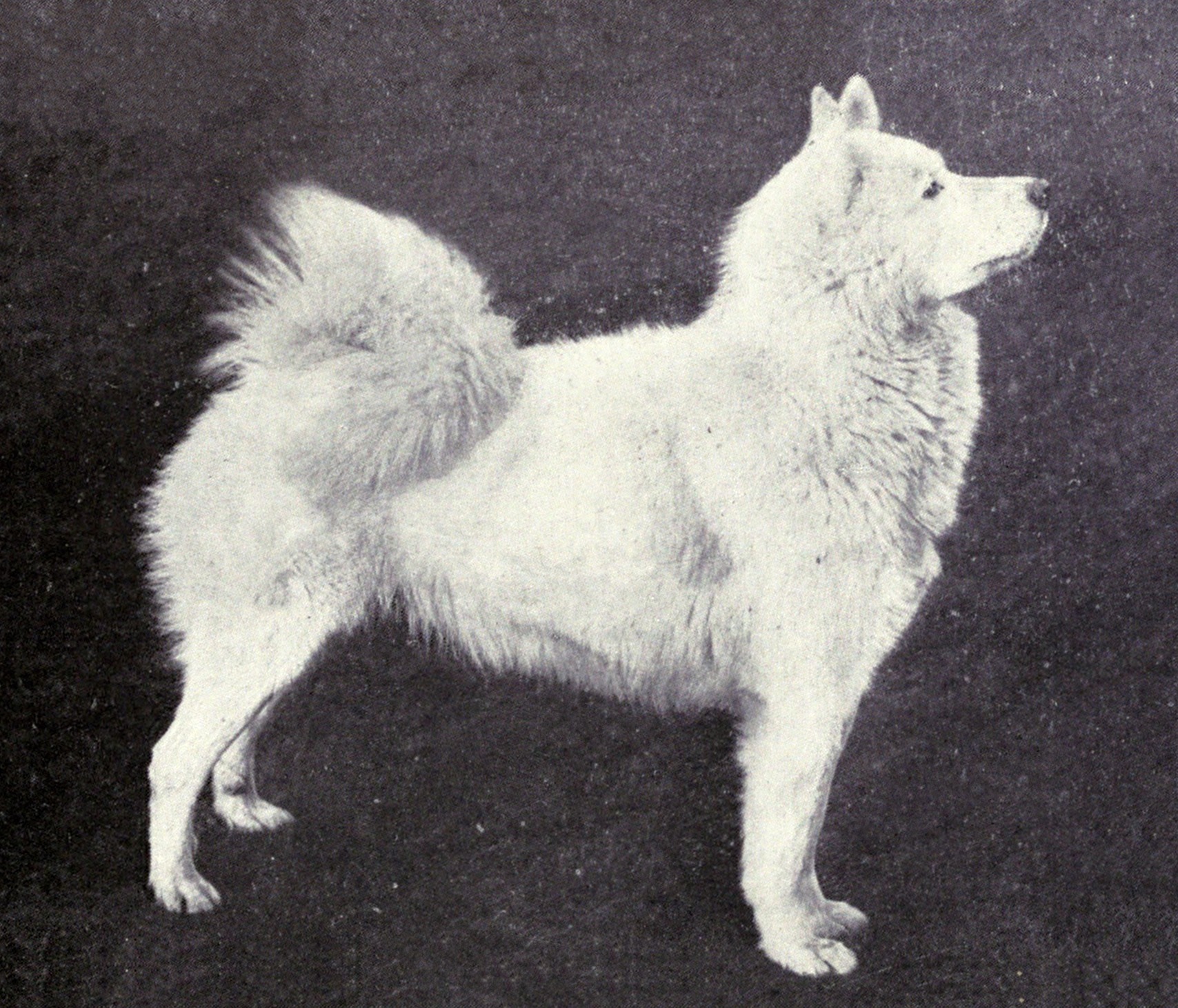
The early twentieth century brought a clearer identity for the Samoyed in Britain. As more dogs were bred and shown, photographs and written descriptions began to record the developing type. They also remind us that a breed does not spring fully formed from a single foundation animal or a single moment in time. Its appearance and character are shaped across generations.
The familiar expression, with its dark almond-shaped eyes and gently upturned corners of the mouth, became part of the Samoyed’s appeal. But a good expression should never overshadow the body beneath the coat. The breed’s history asks us to value sound movement, stamina and balance: qualities that mattered long before a judge examined a dog in a show ring.
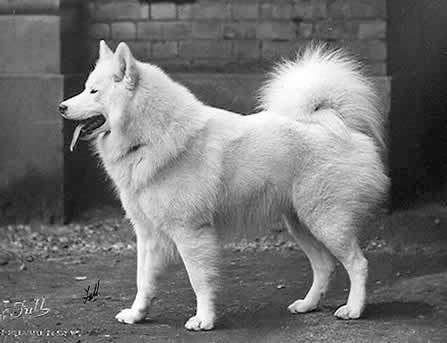

These early photographs offer a glimpse of particular dogs at particular moments. They should not be read as proof that every Samoyed of the period looked alike. Instead, they help us see the breed’s development as a living history rather than an abstract list of dates.
The Working Dog Behind the Smile
A modern Samoyed may spend its days walking in the countryside, enjoying dog sports or resting with its family rather than following reindeer or pulling a working sledge. The setting has changed, but the historical connection between activity and companionship remains meaningful.
The breed’s sociable character is not simply a charming extra. The old accounts of dogs sleeping close to their families, travelling with them and working under their direction help explain why human company is such an important part of the Samoyed’s story. Their background also helps us understand the appeal of varied exercise, purposeful activity and opportunities to use both body and mind.
That does not mean every Samoyed must pull a sledge or run for miles. It means that a dog developed through work and partnership deserves more than admiration for its coat. Walks, training, appropriate sports and everyday adventures can all provide opportunities to engage with the world alongside its people.
A Heritage Worth Keeping
Founded in 1931, the British Samoyed Club became part of the breed’s continuing history in Britain. Its own story belongs alongside the earlier accounts of northern communities, polar journeys and the first British kennels. Read more about the Club’s history.
Preserving the Samoyed means remembering both halves of its identity: a capable northern working dog and a companion accustomed to sharing human life. Its history is not only about explorers, breeders or beautiful photographs. It is about an enduring partnership between dogs and people — a partnership that still deserves to shape how we understand, care for and value the breed today.
Sources & Further Reading
- Fédération Cynologique Internationale — Samoyed, Standard No. 212. Historical summary, early British imports, original working roles and the 1909 standard.
- American Kennel Club — Samoyed History. Early British breeding and the Kilburn-Scott family.
- Fridtjof Nansen, Farthest North, Volume I. First-hand account of the Fram expedition, reflecting the language and perspectives of its period.
- Royal Museums Greenwich — History of Antarctic Explorers. Amundsen and Scott expedition chronology and transport methods.
- Australian Antarctic Program — History of Ground Transportation in Antarctica. The role of dogs, ponies and man-hauling in Antarctic exploration.
- Gregory Alan Newell, Samoyede; The People and Their Dogs. Historical article preserved in the British Samoyed Club’s former website archive; used here as a source of themes and historical context, not as a source of independently verified claims.
- W. E. Mason, Dogs of All Nations (1915). Historical photograph source.