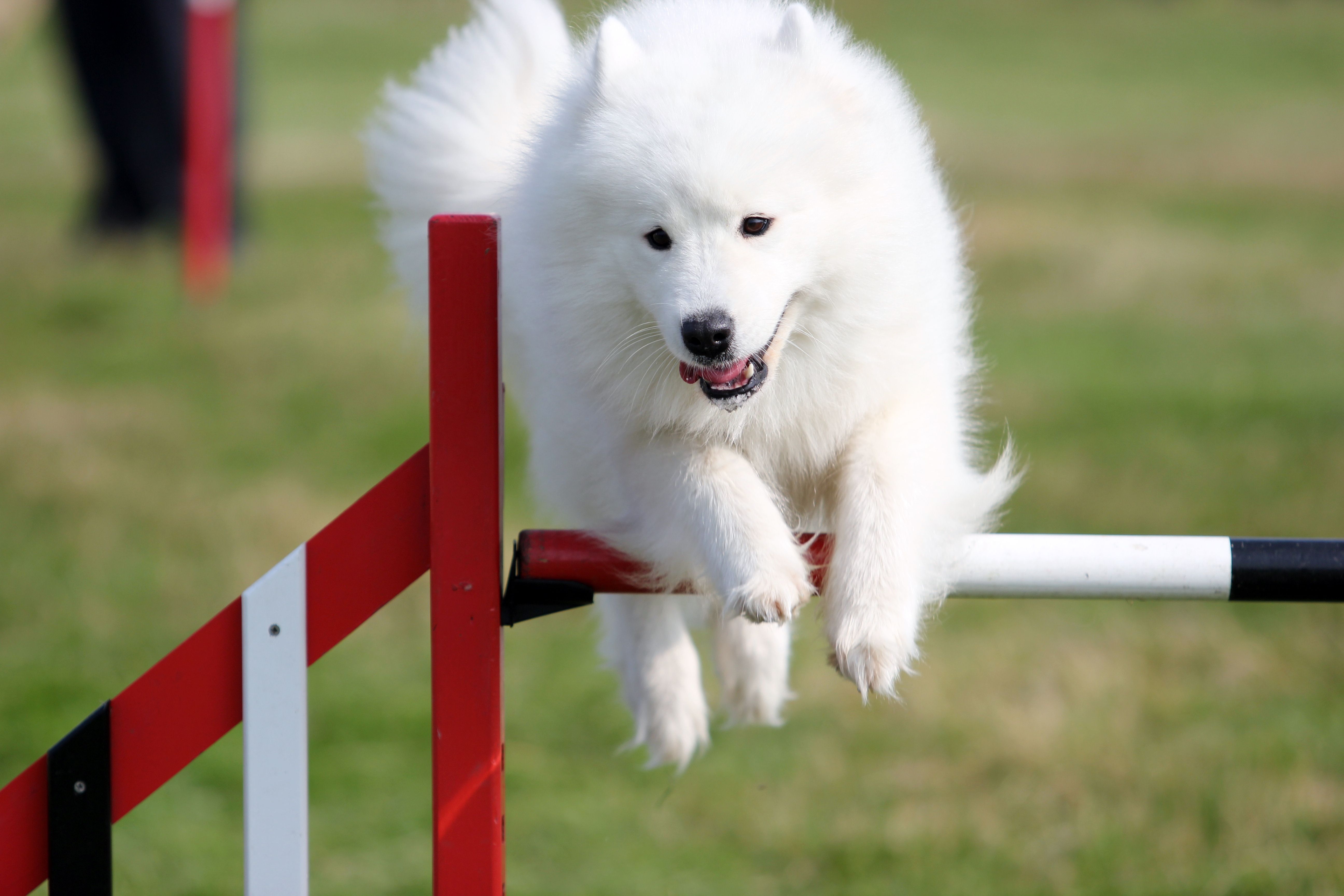
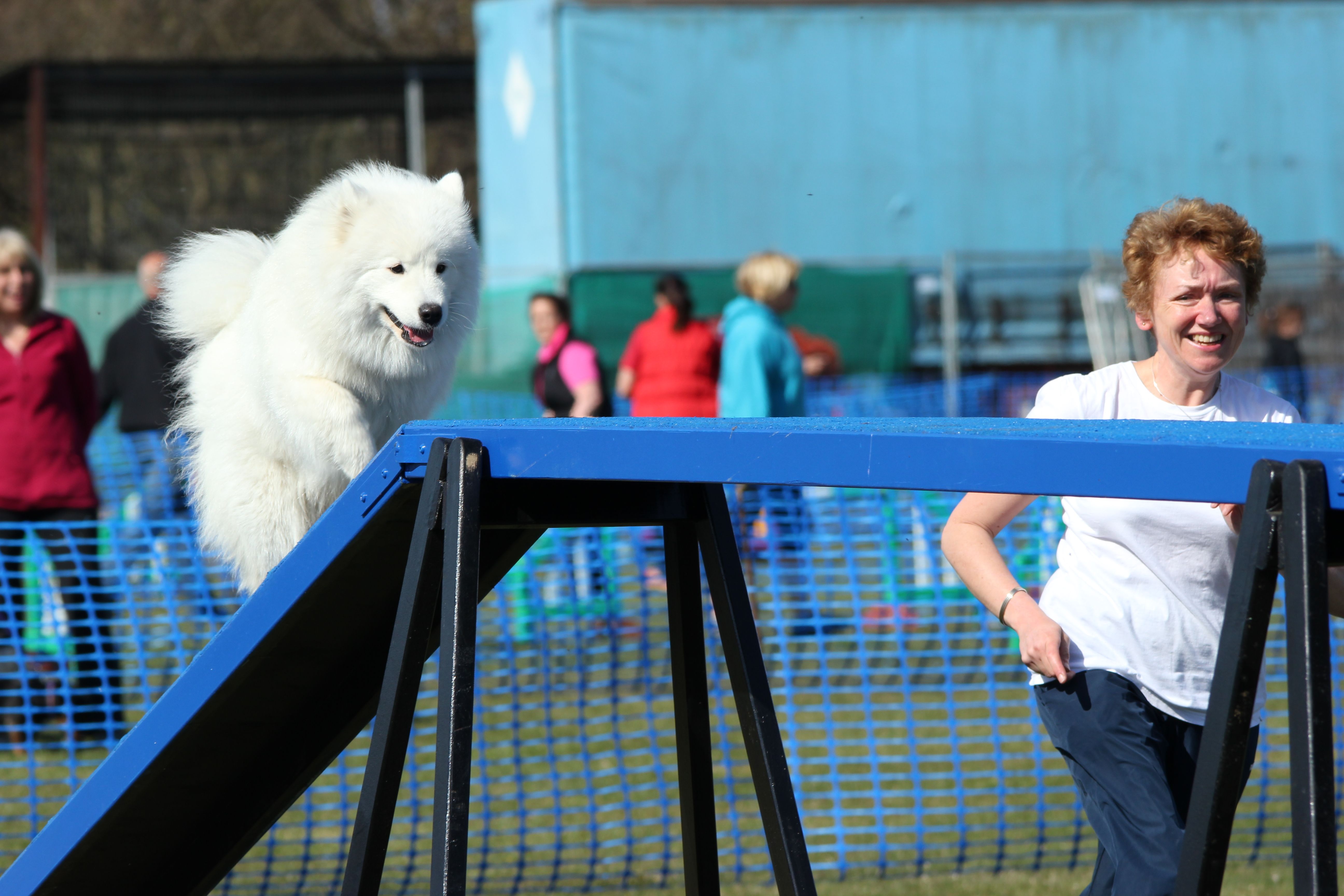
Agility is one of the most exciting canine sports in the UK. It is great fun for everyone — dogs and owners alike — whether you want to participate just for fun or have ambitions of competing at the highest level. It is also a great way to keep fit, build confidence and develop a strong working relationship with your Samoyed.
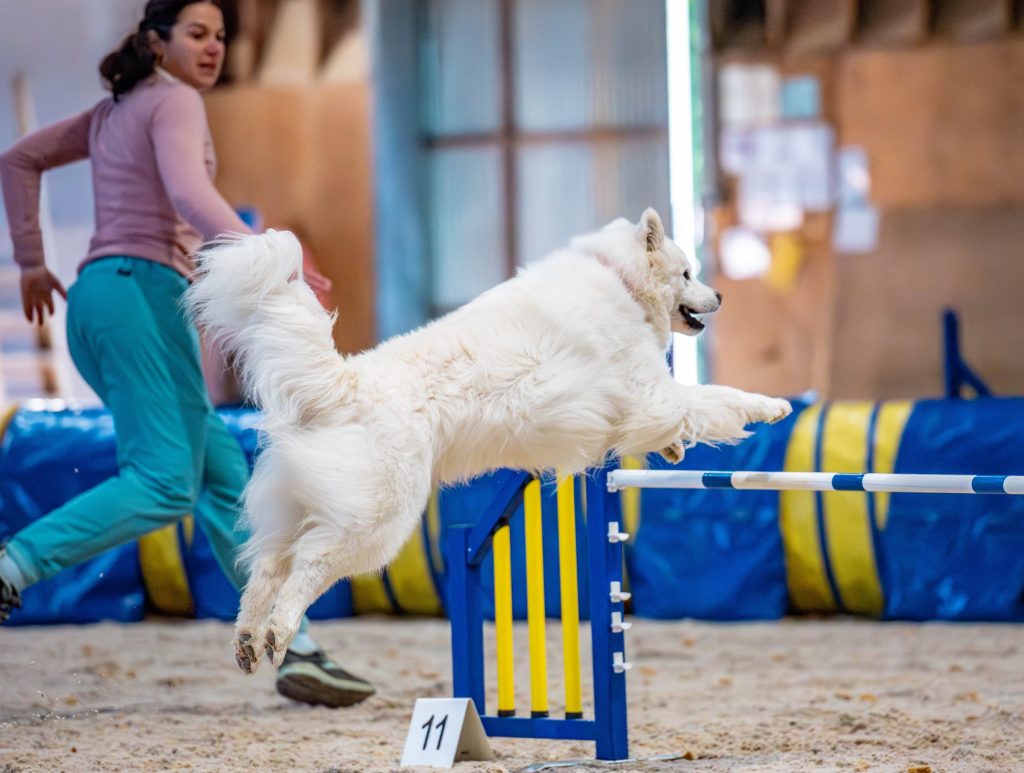
Getting started
So how do you get started in agility?
For safety’s sake, the Royal Kennel Club recommends that dogs do not begin training on agility equipment until they are at least 12 months old. Dogs must be at least 18 months old to compete at Royal Kennel Club licensed agility shows.
However, there is plenty you can do with a younger Samoyed before introducing jumping and more demanding equipment. Basic obedience, recall, body awareness, confidence building and learning to work around distractions are all excellent foundations.
Many agility clubs have waiting lists, so it is worth finding a suitable club early.
Agility is very much a team sport, where you and your dog learn to work together. Some of the most useful basic skills include:
- Reliable recall
- Down on command
- Ability to work around distractions, including other dogs
- Send away
- Working on both your left and right-hand sides
- Staying focused on the handler
A good place to start looking for a club is Agilitynet. You can also use the Royal Kennel Club’s Find a Club service or ask for recommendations at your regular training classes.
As with all dog training, make sure you are happy with the club before joining. Visit, watch a lesson and ask questions. Positive, reward-based training methods are important, and instructors should understand how to work with different breeds.
Some clubs are highly competitive and may have mainly Border Collies, while others welcome a wider variety of breeds and abilities.
Just remember that Samoyeds can be quite independent and may not approach agility in the same way as a Border Collie. Finding an instructor who understands this can make a real difference.
Your first agility lessons
When you finally begin agility lessons, you will usually start with a beginners’ course.
These courses introduce you and your dog to the equipment and teach you how to handle short sequences of obstacles. As your confidence grows, you will gradually progress to longer courses and more advanced handling techniques.
Learning to compete successfully takes time, patience and regular practice. Your instructors will advise you when they think you are ready to enter your first show.
Schedules for many agility shows can be found on Agilitynet.
Understanding agility competitions
The aim in competition is to complete a course in the correct order, as quickly and accurately as possible, with the fewest faults.
Faults can be awarded for:
- Knocking down a jump pole
- Refusing or running past an obstacle
- Missing a required contact area
- Incorrectly entering or negotiating weave poles
- Exceeding the course time
A refusal or run-out normally incurs five faults. Three refusals or run-outs result in elimination.
Some of the main reasons a dog may be eliminated include:
- Taking the wrong course
- Failing to complete the weave poles correctly before continuing
- Being judged out of control
- Fouling the ring
- Wearing an incorrect style of collar
- Receiving assistance from another person during the round
- Certain other breaches of the competition rules
Deliberately touching the dog or equipment is generally penalised with five faults rather than automatic elimination.
Time faults are also added when a dog exceeds the time set for the course.
A clear round — completing the course without faults and within the allowed time — is an achievement in itself, especially when you are starting out.
Many shows offer rosettes for clear rounds as well as class placings.
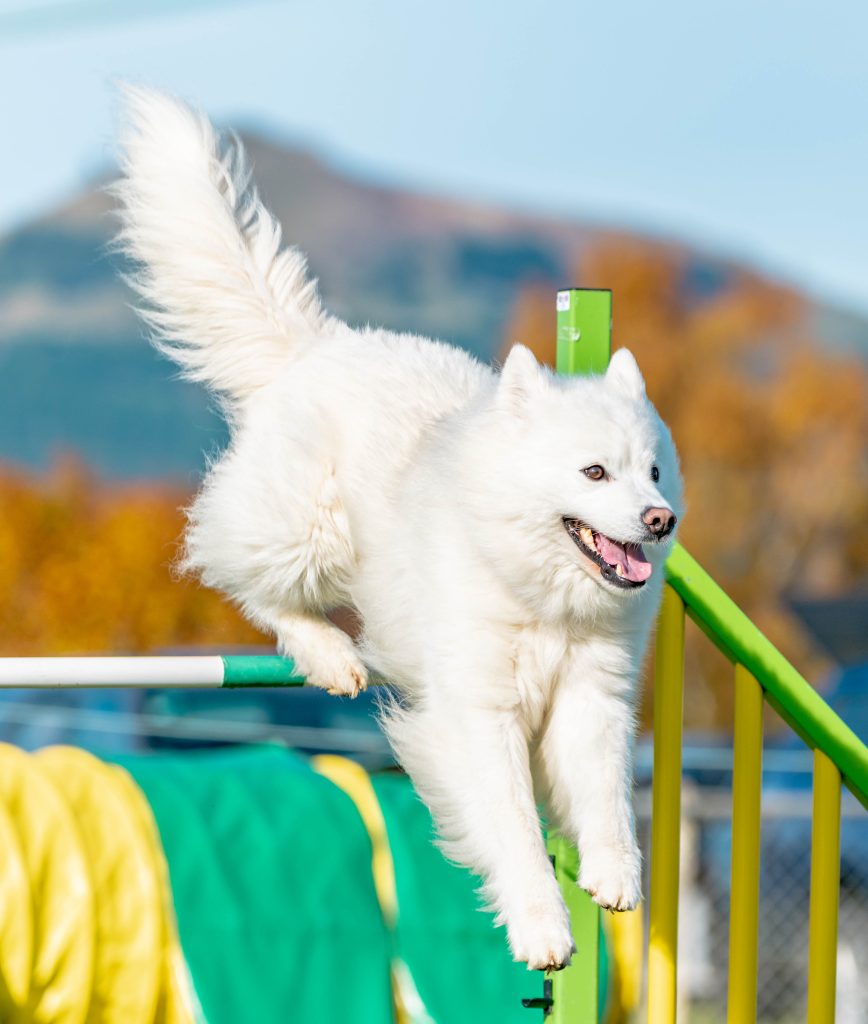
Types of agility shows
There are several types of agility competition in the UK, and the rules can vary between organisations.
The Royal Kennel Club runs licensed agility competitions, while other organisations, including UK Agility International and independent organisers, offer alternative formats.
There are also unaffiliated shows, which can be a useful introduction to competition.
Always read the schedule and the rules of the organisation running the event before entering.
Royal Kennel Club agility
At Royal Kennel Club shows, dogs compete in height categories and grades.
The established height categories are Small, Medium, Intermediate and Large. Dogs are allocated according to their height at the withers.
For standard competition, the corresponding jump heights are:
| Category | Jump height |
|---|---|
| Small | 300 mm |
| Medium | 400 mm |
| Intermediate | 500 mm |
| Large | 600 mm |
Most adult Samoyeds will fall into the Large category, although classification depends on the individual dog’s height.
The Royal Kennel Club’s measuring requirements have also changed. Dogs in Small, Medium and Intermediate must be officially measured before competing. Dogs clearly eligible for Large do not necessarily require an official measurement, although owners should check the current requirements and keep an Agility Record Book.
Competition grades run from Grade 1 to Grade 7.
Grade 1 is the starting point for eligible beginners. However, eligibility also depends on the previous competition achievements of the dog, owner and handler.
To progress from Grade 1 to Grade 2 through wins, a dog must gain two qualifying first places, at least one of which must be in an agility class rather than a jumping class.
There is also an alternative points-based progression system, allowing eligible dogs to progress through the lower grades.
Agility classes include contact equipment such as the A-frame, dog walk and seesaw, while jumping classes do not include contact equipment.
Classes may be graded or combined, and there are also special classes, including ABC (Anything But a Collie) competitions.
The number of entries can be high, particularly in the larger height categories, but that is part of the challenge and excitement of the sport.
Other agility organisations
UK Agility International (UKI) provides another competition option, with its own height categories, measuring requirements, levels and progression system.
Its rules differ from those of the Royal Kennel Club, including the option of Select jump heights for eligible dogs.
For the current rules, visit https://www.ukagilityinternational.com/compete/rules
Other organisations and unaffiliated shows may use different jump heights, scoring systems or eligibility requirements.
It is always worth checking the latest rules rather than assuming that every agility show operates in the same way.
The social side of agility
Agility shows are a great way to meet people from other clubs.
The camaraderie amongst agility enthusiasts is wonderful, with competitors supporting one another and celebrating each other’s achievements.
Many summer shows run over several days, and people often camp at the showground for the weekend with friends. This makes agility a fantastic social occasion for dogs and owners alike.
Most importantly, agility should be enjoyable for both you and your Samoyed. Progress at your dog’s pace, keep training positive and remember that having fun together is just as important as winning.
Many people start agility for a bit of fun — but once the bug bites, your weekends may never be the same!
Further information
- Royal Kennel Club — Getting started in agility: https://www.royalkennelclub.com/newtoagility
- Royal Kennel Club — Agility Regulations 2026: https://www.royalkennelclub.com/media/ho5knkag/h-regs-mini-guide-2026-final-screen.pdf
- UK Agility International — Rules: https://www.ukagilityinternational.com/compete/rules
- Agilitynet: https://www.agilitynet.co.uk/
Regulations reviewed: October 2026. Competitors should always consult the latest official rules before entering a show.